
By the mid-1970s, my natural playground was the slagged cliffs and green-slimed rocks of Workington beach. A rent in the cliffs let you drop over the edge, slide steeply toward a hole in the cliff face, and clamber down through a cave that stank of algae and piss, out onto the coal-jewelled sand.
After school, the evenings were one long play. Dams, castles, and waves marked the hours, and the sun-setting tolled the turn-away-time from the glitter towards the dark town. The mark of the sun, burned on the backs of my eyes, blinded by the dazzle, stayed until bedtime.
Innumerable times, I’d stop to watch the last flares of sunlight die over the Irish Sea, then turn back to the street’s orange lights, and stop, and turn. We passed the dereliction of life-less terraced houses, shells of factories no longer manufacturing, and rusted rail sidings where point-levers could no longer be budged, no matter how many kids hung on them. Without thought, we walked home from a landscape of limitless possibilities through a landscape of decline.
In his 1979 Introduction to Remains of Elmet, a collection of poems and photographs with Fay Godwin, the poet Ted Hughes wrote about growing up in the Calder Valley in West Yorkshire:
You could not fail to realise that cataclysms had happened to the population (in the First World War, where a single bad 10 minutes in no man’s land would wipe out a street or even a village), to the industry (the shift to the East in textile manufacture), and to the Methodism (the new age). Gradually it dawned on you that you were living among the survivors, in the remains. 1
At the same time, a similar perspective of South & West Cumbria had developed through the words of Millom poet Norman Nicholson and the vision of Whitehaven artist Percy Kelly. Both spoke of impoverished communities surviving the loss of iron and steel while embraced by landscapes of extraordinary radiance.
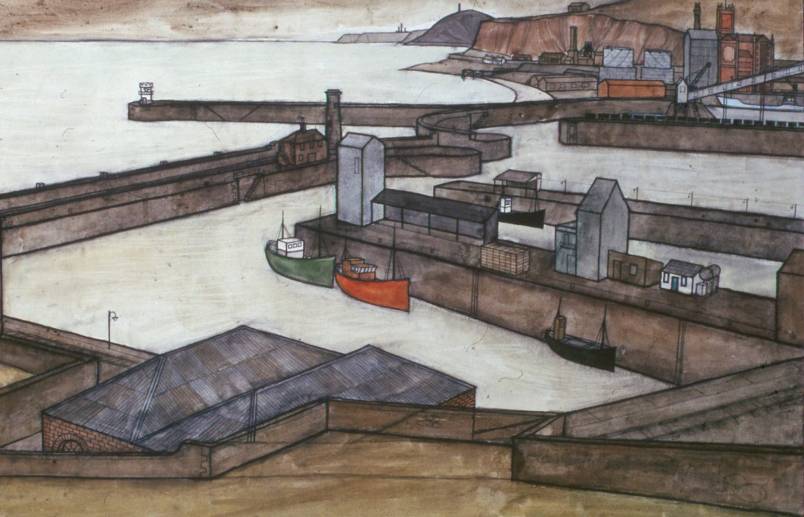
Whitehaven Harbour from the Fan House by Percy Kelly (1918 – 1993)
Kelly drew from a darker, more humble landscape. He emphasised the bleakness of the industrial strip, the forgotten fishing ports that line the Solway coast and the brick terraces of the mining villages. Like Ted Hughes, Norman Nicholson wrote at a time when regional poetry was embraced and respected as a romantic sensation: its roots far from the literary whirlwind of London, a guarantee of authenticity and closer access to the rawness of nature. In the spirit of the times, Nicholson’s poetry and topographical essays nudged Millom and the declining industrial vein of Cumbria back into public consciousness as Wordsworth’s Guide to the Lakes had done in 1810.
In 1981, Faber & Faber published Sea to the West 2. It was to be Norman Nicholson’s last published collection of poetry before he died in 1987. Everything about its title poem resonated with the evenings I’d spent watching the sunset over the Irish Sea from Workington beach:
When the sea’s to the west
The evenings are one dazzle –
You can find no sign of water.
Sun upflows the horizon;
Dazzle became Nicholson’s perfect analogy for Sun glitter, that composition of innumerable glints, formed by the sun’s rays reflecting off the water’s surface. The glitter dances as the moving waters devise a new set of reflections. At every moment, each witness observes a unique dazzle.
In Sea to the West, a fifteen-year-old schoolboy, leaning on handlebars, would stare out across the Irish Sea and let the sun burnish the glitter onto the backs of his eyes, being blinded by dazzle.
Once, fifteen,
I would lean on handlebars,
Staring into the flare,
Blinded by looking,
Letting the gutterings and sykes of light
Flood into my skull.
With the sun low in the western sky, the glitter trail stretched from the horizon toward the shore. It took on the colour
of the setting sun with a palette of reds, oranges and yellows. At this time, you could stare right into the sun without hurting your eyes and witness the colours change. When all that glitters is not gold, it would be crimson, salmon, or purple.
Then, on the stroke of bedtime,
I’d turn to the town,
Cycle past purpling dykes
To a brown drizzle
Where black-scum shadows
Stagnated between backyard walls.
I pulled the warm dark over my head
Like an eiderdown.

Yet in that final stare when I
(Five times, perhaps, fifteen)
Creak protesting away –
The sea to the west,
The land darkening –
In 1987, Norman Cornthwaite Nicholson was buried in St. Georges Churchyard, Millom. On his gravestone, the last three lines of the poem:
Let my eyes at the last be blinded
Not by the dark
But by the dazzle.
No responses yet